The Child Is Not Weak. The System Around the Child Is Weak.
In many rural communities in Ghana, there is a painful story we do not talk about enough.
A child wakes up before sunrise. Before going to school, he may have to fetch water, sweep the compound, help on the farm, take care of younger siblings, or walk a long distance before reaching the classroom.
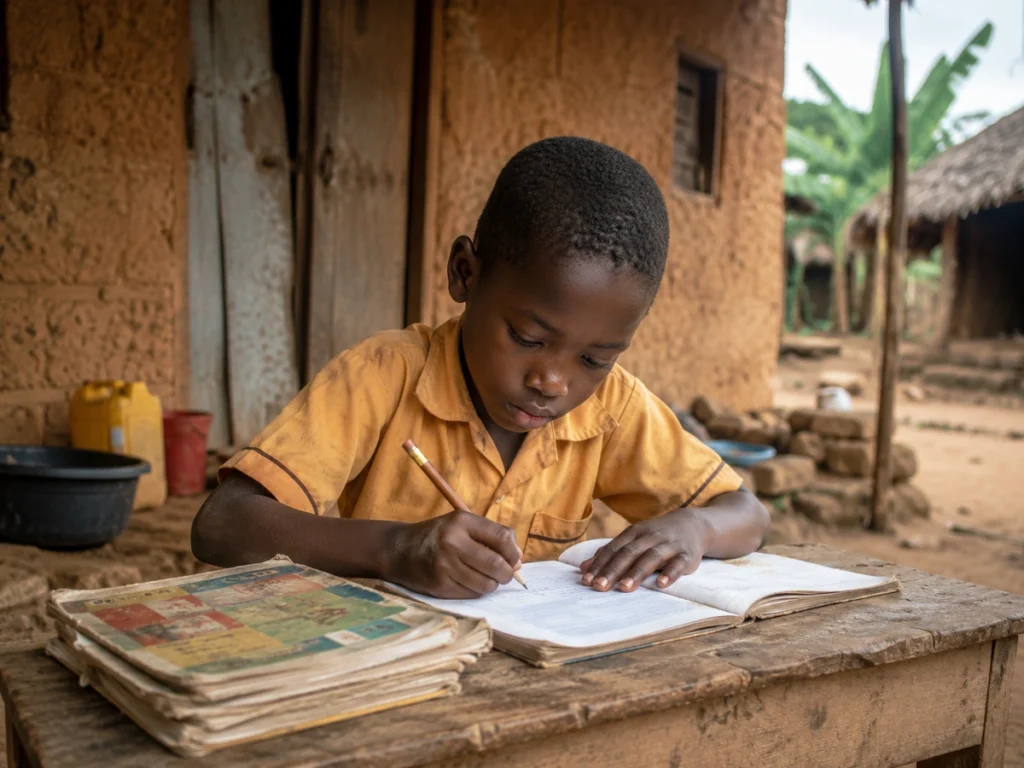
By the time that child arrives at school, he is already tired.
He enters a classroom where there may be few textbooks, no computer, no projector, no library, and sometimes not enough teachers. At home, there may be no quiet place to study, no internet, no extra classes, and no one available to help with homework.
Then, when the exam results come, someone looks at the marks and says:
“This child is weak.”
But is the child really weak?
Or has the child been asked to compete without the same support, the same resources, and the same opportunities as others?
The truth is simple but painful: many rural students in Ghana are not weak. They are under-supported.
They are intelligent. They are talented. They are full of potential. But potential alone is not enough. A seed can be good, but if the soil is poor, if there is no water, and if there is no sunlight, that seed will struggle to grow.
That is what is happening to many children in rural Ghana.
1. Poverty Makes Learning Difficult
One of the biggest reasons many rural students struggle is poverty.
In some homes, education is important, but survival comes first. Some children go to school hungry. Some miss classes during farming seasons. Some sell after school. Some help their parents at the market. Some look after younger siblings while their parents work.
By evening, they are too tired to revise.
For example, a hungry child cannot concentrate like a child who had breakfast. A child who walks several kilometres to school cannot learn with the same energy as a child who is driven to class. A child who studies under poor lighting cannot compete fairly with a child who has electricity, internet, textbooks, and educated support at home.
This is not laziness.
This is not lack of intelligence.
This is inequality.
When a rural student performs poorly, the report card may show low marks, but behind those marks may be hunger, tiredness, poverty, stress, and lack of support.
2. Many Rural Schools Do Not Have Enough Learning Materials
A good teacher can do a lot, but even the best teacher struggles without the right materials.
In some rural schools, pupils share textbooks. Some classrooms have no charts, no practical tools, no ICT lab, no science equipment, and no library.
Imagine learning ICT without touching a computer.
Imagine learning science without seeing simple experiments.
Imagine preparing for BECE without enough practice questions.
Imagine trying to improve your English when you do not have storybooks to read.
This is the reality for many rural children.
The problem is not that they cannot learn. The problem is that they are often expected to perform well without the tools that make learning easier.
3. Some Children Have Weak Foundations from the Early Years
Many students struggle in JHS not because JHS work is impossible, but because they missed important basics in primary school.
A child who cannot read well will struggle in almost every subject. English becomes difficult. Science becomes difficult. Social Studies becomes difficult. Even Mathematics becomes difficult when the child cannot understand word problems.
A child who does not understand basic addition, subtraction, multiplication, and division will later struggle with fractions, percentages, algebra, and problem-solving.
This is why early learning is so important.
If the foundation is weak, everything built on it becomes shaky.
Unfortunately, many children are promoted from class to class even when they have not fully understood the previous work. By the time they get to upper primary or JHS, the learning gap has become too wide.
Then we blame the child.
But the real question should be:
Who noticed the child was struggling?
Who helped the child early?
Who went back to rebuild the foundation?
4. Teacher Shortage and Teacher Motivation Affect Learning
Many rural schools struggle to attract and keep trained teachers.
Some teachers posted to remote areas face poor roads, limited accommodation, lack of teaching materials, and little professional support. Some classrooms are overcrowded. In some places, one teacher may handle too many pupils at different learning levels.
When teachers are absent, transferred frequently, or overwhelmed, children suffer.
A child who needs personal attention may never receive it. A quiet child may sit at the back of the class for years without anyone noticing that he cannot read properly. Another child may copy notes every day without understanding them.
As a result, the child may be present in school, but real learning may not be taking place.
This is one of the hidden tragedies of rural education.
5. Language Can Become a Barrier
Many rural children grow up speaking their local language at home. But as they move through school, they are expected to read, write, and answer questions in English.
English is important, but the transition is not always easy.
Some children understand the idea when it is explained in their local language, but they struggle to express it in English. Some know the answer but cannot write it correctly. Others misunderstand exam questions because the language is too difficult.
This does not mean the child is unintelligent.
It means the child needs patient teaching that connects local understanding with academic English.
When language becomes a barrier, confidence drops. A child who is afraid of making mistakes may stop participating in class. Over time, the child begins to believe, “I am not good in school.”
That belief can destroy motivation.
6. Many Parents Care, But They Do Not Always Know How to Help
Some people blame rural parents when children struggle. But the issue is more complex.
Many rural parents care deeply about their children’s education. They want their children to become teachers, nurses, doctors, engineers, entrepreneurs, and leaders. But some parents did not go far in school themselves. Some cannot help with homework. Some are busy trying to provide food for the family.
So the child goes to school, returns home, and receives little academic support.
In many urban homes, children may have extra classes, private tutors, learning apps, internet access, storybooks, and educated adults around them. But in many rural homes, the classroom teacher may be the child’s only academic support.
That is not enough.
Education must become a shared responsibility between schools, parents, communities, old students, churches, mosques, NGOs, government, and digital learning platforms.
7. Poor School Infrastructure Affects Learning
Some rural children learn under very difficult conditions.
There may be no proper desks. Some classrooms are overcrowded. Some schools lack electricity. Some do not have clean toilets, water, libraries, or ICT facilities. During the rainy season, bad roads can prevent children from attending school regularly.
These things affect performance.
A child’s environment affects concentration. A child who is uncomfortable, hungry, tired, or unsafe cannot give their best.
We cannot ignore the learning environment and still expect excellent results.
8. Low Confidence Becomes a Silent Enemy
One of the saddest effects of poor learning support is low self-confidence.
After failing several times, some children stop trying. They stop raising their hands in class. They stop asking questions. They compare themselves to others and feel ashamed.
Some become quiet. Some become stubborn. Some start missing school. Some sit in class physically present but mentally absent.
This is how many children are lost.
Not because they are not intelligent, but because they have failed so many times that they no longer believe improvement is possible.
A struggling child does not need insults.
A struggling child needs patience, encouragement, practice, and someone who believes in them before they can believe in themselves again.
What Can Be Done?
1. Stop Calling Children Weak
The first solution is to change the language we use.
When we call a child weak, we make the child feel like failure is part of who they are. But when we say the child has a learning gap, we can begin to fix the problem.
A child may struggle with reading today and become a strong reader tomorrow. A child may fail Mathematics now and later become excellent with the right support.
We should stop labelling children and start identifying what they need.
The better question is not:
“Why is this child weak?”
The better question is:
“What support does this child need?”
2. Focus on Reading, Writing, and Basic Mathematics Early
Every child must be helped to build strong foundational skills.
Before children move too far in school, they must be able to read, write simple sentences, understand basic English, and solve basic Mathematics problems.
Schools should regularly check whether children can read and calculate at the right level. Those who are behind should receive extra support early.
We should not wait until BECE before we start worrying.
By then, the problem may have become too big.
3. Teach Children at Their Real Level
Not every child in the same class is at the same learning level.
Some JHS students may still have primary-level reading challenges. Some upper primary pupils may still struggle with basic multiplication. If all students are taught the same way at the same speed, many will be left behind.
Teachers should identify where each child is struggling and support them step by step.
Some children need to go back to basics, not because they are dull, but because something was missed earlier.
Learning should not be about rushing through the syllabus. It should be about making sure children truly understand.
4. Use Digital Learning to Support Rural Students
Technology can help close the gap if it is used wisely.
Many rural students may not have access to extra classes or private tutors, but with mobile phones, tablets, offline lessons, quizzes, and educational apps, they can continue learning beyond the classroom.
This is where KwikLearn can play an important role.
KwikLearn can support rural learners with:
- Simple explanations of difficult topics
- Short lessons students can understand easily
- BECE-style practice questions
- Quizzes with instant feedback
- Revision materials for core subjects
- Learning support for low-end devices
- Study content students can use after school
Digital learning should not replace teachers. It should support teachers, parents, and students.
A rural child with the right digital support can revise more, practise more, and slowly rebuild confidence.
5. Create Community Learning Centres
Every rural community should consider creating a simple learning centre.
It does not need to be expensive. A church hall, mosque space, community classroom, or small library corner can be used.
Children can gather after school to read, practise Mathematics, revise lessons, and receive guidance from volunteers, retired teachers, national service personnel, old students, or educated youth in the community.
Even two hours of serious learning support after school can change a child’s future.
The community that supports its children today will produce tomorrow’s teachers, nurses, engineers, business owners, and leaders.
6. Support Teachers in Rural Areas
If we want rural students to perform better, we must support rural teachers better.
Teachers need teaching materials, accommodation support, training, motivation, and respect. A teacher who feels abandoned cannot give their best. A teacher who has no resources will struggle.
Government, district education offices, NGOs, old students, and communities must work together to make rural teaching more effective and attractive.
When teachers are supported, students benefit.
7. Provide More Books and Reading Opportunities
Reading can change a child’s life.
A child who reads well can learn independently. A child who cannot read will struggle in almost every subject.
Rural schools need reading clubs, storybooks, small libraries, spelling activities, storytelling sessions, and reading competitions.
Parents who cannot read English can still help by giving children time to study, encouraging them to read aloud, and showing interest in their schoolwork.
A book in the hands of a rural child can open a door the child has never seen before.
8. Feed the Child, Then Teach the Child
A hungry child cannot learn properly.
Nutrition must be part of the education conversation. School feeding programmes, community support, and parental involvement can help improve attendance and concentration.
Sometimes, the difference between a child staying in school and dropping out is a simple meal.
We cannot separate the child’s brain from the child’s body.
If the body is weak, the mind will struggle.
9. Involve Parents Without Shaming Them
Parents must be part of the solution, but they should not be shamed.
Many parents want to help but do not know how. Schools should guide parents in simple ways.
Parents can help by:
- Making sure children attend school regularly
- Giving children time to study at home
- Reducing unnecessary chores during school days
- Asking to see exercise books
- Attending PTA meetings
- Encouraging children instead of insulting them
- Seeking help early when a child is struggling
Even when parents cannot teach the subject, their encouragement can make a big difference.
10. Give Rural Children Hope
Hope is powerful.
When a child believes improvement is possible, the child tries again. When a child receives encouragement, the child becomes more confident. When a child starts getting small answers correct, the child begins to believe, “Maybe I can do this.”
That is how learning grows.
Many rural children do not need pity. They need opportunity.
They do not need to be called weak. They need support.
They do not need to be forgotten. They need someone to notice them.
Conclusion: Rural Children Are Full of Untapped Potential
There are brilliant children in Ghana’s rural communities.
Some are future doctors, but today they do not have enough textbooks.
Others may become engineers, even though they have never touched a computer.
Another child may become a great writer, but has never had enough storybooks to read.
Some are future business leaders, but they are selling after school to survive.
Some are future scientists, but they are learning science without a lab.
Some are future national leaders, but they are sitting quietly at the back of the classroom because they think they are not intelligent.
We must stop seeing rural students as weak.
We must see them as children who need stronger support, better resources, patient teaching, digital learning tools, and a community that believes in them.
The child in the rural classroom is not a failure.
The child is a seed.
And when that seed receives the right care, it can grow into something powerful.
At KwikLearn, we believe every child deserves access to quality learning support, no matter where they live. Whether a child is in Accra, Kumasi, Tamale, Takoradi, Wa, Bolgatanga, or a small village far from the city, education should not be limited by location.
Because when rural children rise, Ghana rises with them.