
The night before an exam can feel very long. Your notes suddenly look too many, your heart starts beating faster, and even topics you studied last week may seem unfamiliar. That is why exam stress management for students matters so much. Stress before tests is common, but when it grows too strong, it can affect memory, focus, sleep, and confidence.
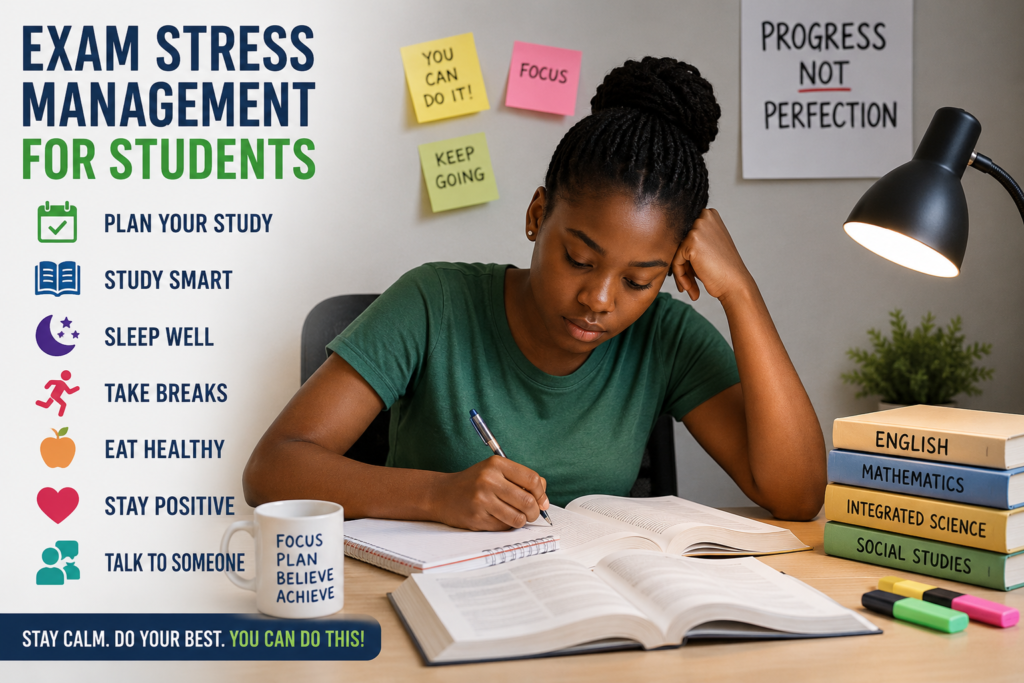
The good news is that exam stress is not a sign that you are weak or unprepared. In many cases, it means you care about your results. The key is learning how to manage that pressure so it does not control you. Whether you are preparing for a class test, BECE, WASSCE, or another important exam, a few steady habits can make a big difference.
What exam stress really looks like
Exam stress does not always appear in the same way. For one student, it may feel like fear and overthinking. For another, it may show up as tiredness, headaches, poor sleep, stomach discomfort, or sudden irritation. Some students become extra serious and quiet. Others avoid studying completely because they feel overwhelmed.
A small amount of pressure can help you take your studies seriously. Too much pressure usually does the opposite. A student may read the same page many times without understanding it. Simple facts can suddenly feel difficult to remember. Comparing yourself to classmates may also make you believe you are behind, even when that is not true.
This is where honest exam stress management for students becomes helpful. It is not about pretending you are never afraid. It is about knowing what to do when fear starts affecting your performance.
Why students feel overwhelmed before exams
Sometimes the stress is caused by poor preparation. If you have not started early, your brain knows the workload is heavy. But that is not the only reason. Many students also feel pressure from parents, teachers, school expectations, or their own goals. If everyone around you keeps saying, “This exam will decide your future,” stress can rise quickly.
Access to support also matters. Some students have quiet spaces, textbooks, internet access, and extra lessons. Others study in noisy homes, share materials, or prepare with limited guidance. That difference can increase anxiety. Stress is not only about mindset. Sometimes it is connected to real challenges in a student’s environment.
That is why students should be careful with advice that sounds too simple. Telling someone to “just relax” does not solve much. Real support includes better planning, healthy routines, and practical ways to stay calm under pressure.
Exam stress management for students starts with a realistic plan
One of the best ways to reduce stress is to stop carrying your whole study load in your head. Write it down. When every subject, topic, and deadline is sitting in your mind at once, everything feels urgent. A study plan helps you turn panic into action.
Start by listing the subjects you need to revise. Then break each subject into smaller topics. Instead of writing “Study Science,” write something clearer like “Revise ecosystems,” “Practice forces and motion questions,” or “Review past objective questions.” Small tasks feel easier to start and easier to finish.
Be realistic with your timetable. A plan that says you will study for 10 hours every day may look serious, but it often fails. Most students do better with focused study sessions and short breaks. If your home is busy during the day, use the hours when you are naturally calmer. If mornings work better for you, protect that time.
A plan should guide you, not punish you. If you miss one session, do not throw away the whole timetable. Adjust it and continue.
Study in a way that helps your brain remember
Stress becomes worse when students spend hours reading without results. Active revision is usually better than passive reading. This means testing yourself, solving questions, explaining answers aloud, and practicing with past papers.
When you answer questions from memory, your brain works harder, and that helps learning stick. It also shows you what you truly know and what still needs attention. This can feel uncomfortable at first, but it reduces fear because you are facing weak areas early instead of discovering them in the exam hall.
It also helps to mix subjects across the week instead of reading only one subject for too long. If you study one difficult topic for hours, frustration can build. Switching between subjects can keep your mind fresh.
Group study can help too, but it depends on the group. A good study group keeps time, asks questions, and stays focused. A distracting group can increase stress because it wastes time and creates more worry.
Protect your sleep, even during revision season
Many students try to fight exam fear by sleeping less. It feels productive, but it often backfires. Your brain needs sleep to store information and recover. If you sleep very late every night, you may become more forgetful, more emotional, and less able to concentrate.
You do not need perfect sleep to do well, especially during a busy exam season. But you do need enough rest to think clearly. Try to keep a steady bedtime as much as possible. Reduce long late-night phone use before sleeping, especially if social media leaves you feeling tense or distracted.
The night before an exam is not the time to force your brain through heavy new topics. Light review is fine. Panic-reading until 2 a.m. usually creates more confusion than confidence.
Your body affects your mind more than you think
When students hear advice about stress, they often expect only mental strategies. But your body plays a big role. If you are dehydrated, hungry, tense, or exhausted, stress feels stronger.
Eat simple meals that give you energy. Drink water regularly. Move your body a little, even if it is just a short walk or stretching between study sessions. Physical movement can reduce tension and help your mind reset.
Breathing also matters. When anxiety rises, your breathing may become fast and shallow. Slowing it down can calm your body. Try breathing in slowly, holding for a moment, and breathing out gently. It sounds small, but it can help before studying and just before an exam begins.
How to calm yourself on exam day
Exam day nerves are normal. Even well-prepared students feel them. The goal is not to remove every nervous feeling. The goal is to stay steady enough to think clearly.
Wake up early enough to avoid rushing. Get your materials ready ahead of time. Eat something light if you can. If classmates start discussing difficult topics at the last minute and it makes you panic, step away. Those final-minute conversations help some students, but they disturb others.
Once you receive the paper, take a moment before starting. Read instructions carefully. Begin with questions you understand if the format allows it. This helps you settle in and build confidence. If your mind goes blank, pause, breathe, and move to another question. Sometimes your memory returns when the panic reduces.
When stress becomes too much
Some stress is expected, but there are times when a student needs more support. If you are having constant panic, frequent crying, extreme fear, chest tightness, hopelessness, or you cannot study at all for days, speak to someone you trust. That could be a parent, teacher, school counselor, older sibling, or mentor.
Asking for help is not weakness. It is wisdom. Sometimes students wait too long because they think they must handle everything alone. But support can make a real difference, especially during high-pressure exam periods.
Parents and teachers also have a role here. Encouragement works better than constant threats. Students do need discipline and structure, but fear-based pressure can reduce confidence. A calm word, a practical routine, and emotional support often help more than repeated warnings.
Building confidence little by little
Confidence does not usually appear all at once the night before an exam. It grows from repeated small actions. Each time you complete a revision session, answer practice questions, correct mistakes, and keep going, you build trust in yourself.
This is important because many students think confidence should come first. In reality, action often comes first. Then confidence follows. You may still feel nervous, but you can also feel ready.
If you are preparing for an important exam right now, do not focus only on how far you still have to go. Look at the next task. Finish that. Then do the next one. Steady progress is often more powerful than last-minute pressure.
At KwikLearn, we believe students do better when they are supported with clear guidance, realistic strategies, and encouragement that feels honest. Exams matter, but your health, confidence, and long-term growth matter too. Prepare seriously, rest properly, and remind yourself that one paper does not define your whole future.
UNICEF also advises students to rest well because good sleep supports both mental and physical wellbeing before exams.