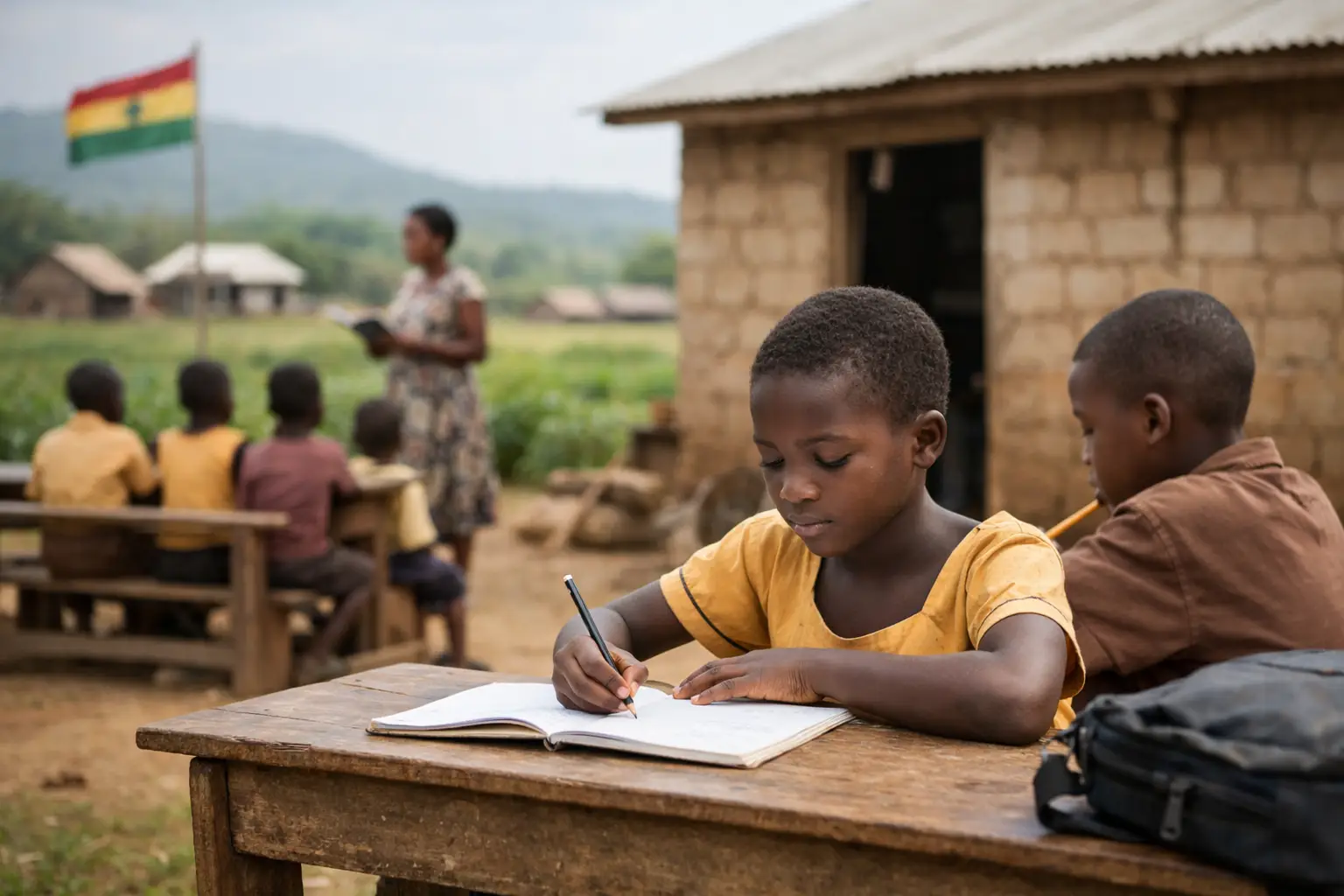
A child who walks more than an hour to school, studies in an overcrowded classroom, and goes home to no electricity is not starting from the same line as a child with books, internet, and regular teacher support. That is the everyday reality behind many education challenges in rural Ghana. When people talk about poor performance, low confidence, or school dropout in these communities, the conversation has to start with the conditions students are learning in.
This matters because talent is not only found in cities. Rural Ghana is full of bright students, committed teachers, and parents who care deeply about education. The problem is that effort alone cannot fix weak infrastructure, limited learning materials, or long-standing inequality. If we want better outcomes, we have to look honestly at what is holding learners back and what can help them move forward.
Why education challenges in rural Ghana persist
One of the biggest reasons these problems continue is that they are connected. A school may not only lack textbooks. It may also have too few teachers, poor roads, no library, unreliable electricity, weak phone network, and families facing financial pressure at home. That means one challenge often leads to another.
For example, when a community is far from major towns, it can be harder to attract and retain trained teachers. When teachers are few, class sizes increase or some subjects are not taught well. When subjects are not taught well, students lose confidence and may perform poorly on exams. Poor results can then make parents question the value of schooling, especially when a child is also needed to help with farming, trading, or housework.
This is why quick fixes rarely work. Donating a few books helps, but it will not solve attendance problems caused by distance, poverty, or unsafe learning spaces. Real improvement usually comes from patient, local, practical support.
Access is still a serious problem
In some rural communities, getting to school is a challenge on its own. Young children may walk long distances, sometimes through difficult roads or bad weather. During the rainy season, attendance can drop because roads become harder to use. For older girls in particular, long travel distances can also raise safety concerns.
Even where schools exist, the facilities may not support proper learning. Some classes still take place in temporary structures or under trees. Others have broken furniture, poor ventilation, and limited protection from heat or rain. It is hard to stay focused in that kind of environment, and teachers also struggle to manage lessons well.
Access is not only about being enrolled. A child may be officially in school but still have weak access to real learning if the classroom is unstable, the timetable is irregular, or important subjects are not consistently taught.
The shortage of teachers affects learning quality
A school building alone does not teach children. Teachers do. Yet many rural schools face shortages of trained and motivated teachers, especially for English, math, science, and ICT. In some cases, one teacher handles multiple grade levels or subjects outside their area of strength.
This affects more than exam scores. It influences how students understand lessons, ask questions, build confidence, and prepare for the next level of education. A learner who repeatedly misses strong foundations in basic literacy or numeracy may continue moving through school without truly mastering core skills.
There is also the issue of teacher retention. Some educators posted to rural areas face housing problems, transport difficulties, or limited professional support. That can make long-term commitment difficult. It depends on the community and district, of course, because some rural schools have exceptional teachers who stay and make a huge difference. Still, the broader pattern shows that staffing remains uneven.
Learning materials are often too limited
In many low-resource schools, students share textbooks, write notes from the board because there are no printed materials, and have very little access to practice exercises. For BECE and WASSCE preparation, this creates a clear disadvantage. A student cannot revise well without enough questions, explanations, and feedback.
The gap becomes even wider when we consider digital learning. Many students in urban areas can watch tutorial videos, join online classes, search for explanations, or practice with digital tools. In rural areas, internet access, smartphones, laptops, and reliable electricity are still limited for many families and schools.
That does not mean digital learning is impossible in rural communities. It means solutions must match the reality on the ground. Offline resources, shared devices, printed revision guides, solar-powered tools, and community learning centers may be more useful than assuming every student can learn online at any time.
Poverty shapes school attendance and performance
We cannot discuss education challenges in rural Ghana without discussing household income. Many families value education but still struggle to pay for uniforms, exercise books, transportation, extra classes, or exam-related costs. When money is tight, schooling competes with daily survival.
Some students miss classes because they help with farming, fishing, market work, or caring for younger siblings. Others attend school hungry, which affects concentration and memory. A child may look quiet or distracted in class, but the real issue may be stress at home rather than lack of ability.
Poverty also affects decisions about staying in school. If parents do not see visible progress, or if immediate income seems more practical than long-term education, dropout becomes more likely. This is especially painful because students who leave school early often have fewer opportunities later.
Language, confidence, and exam pressure
Another challenge is the gap between home language and school language. Some children begin school speaking a local language and then have to learn through English before they are fully comfortable. That transition can slow comprehension, especially in the early years.
When students do not understand lessons well from the start, they may become quiet, fearful of making mistakes, or less willing to participate. Over time, low confidence becomes a learning barrier on its own. By the time they reach major exams, some students are not only battling content difficulty. They are also battling years of self-doubt.
This is where supportive teaching matters. Encouragement, repetition, local examples, and consistent practice can make a big difference. Students learn better when they feel safe to ask questions and try again.
What can actually help rural schools improve
Progress is possible, but it works best when communities, schools, government, and partners each play a clear role. One helpful step is investing in basics first: safe classrooms, desks, toilets, water, electricity, and enough teaching materials. These are not luxuries. They shape attendance and learning every day.
Teacher support is also essential. Rural schools need not only teacher deployment but also housing support, mentoring, training, and encouragement to stay. A motivated teacher in a difficult setting can change many lives, but that teacher should not be left to struggle alone.
Parents and guardians matter too. Even when formal education levels are low, families can still support learning by checking attendance, protecting study time, asking about homework, and encouraging children not to give up. Community involvement often improves accountability because schools do better when people are paying attention.
For students, practical support works better than empty motivation. Revision clubs, peer study groups, holiday lessons, reading corners, and access to past questions can strengthen performance. This is one reason platforms like KwikLearn can be useful when they provide simple, accessible learning help that matches what students actually need.
Technology can help, but only if it fits the local context. A school with no stable internet may benefit more from offline educational content than from a fully online system. A shared tablet lab may be more realistic than expecting every learner to own a device. The goal is not to copy urban solutions blindly. The goal is to improve learning in ways that rural communities can sustain.
A better future is possible
The story of rural education should never be told as a story of hopelessness. Yes, the barriers are real. But so is the potential. Across Ghana, there are students in village schools who are eager to learn, teachers doing their best with very little, and communities that still believe education can change a child’s future.
What they need is not pity. They need fair support, practical investment, and steady attention. When rural learners get qualified teachers, useful materials, safe classrooms, and the chance to build confidence step by step, they can thrive. The next big success story may already be sitting in a low-resource classroom, waiting for the right support to make learning possible.