
The WASSCE results are out, and suddenly everyone has an opinion. One auntie says go to university. A friend says learn a trade. Another person says find work first. If you are thinking about career options after WASSCE, the truth is simple – there is no one correct path for every student.
What matters is choosing a path that fits your results, interests, finances, and long-term goals. Some students will continue straight to higher education. Others may build a strong future through technical training, apprenticeships, entrepreneurship, or digital skills. A good decision is not the most popular one. It is the one that gives you a realistic way forward.
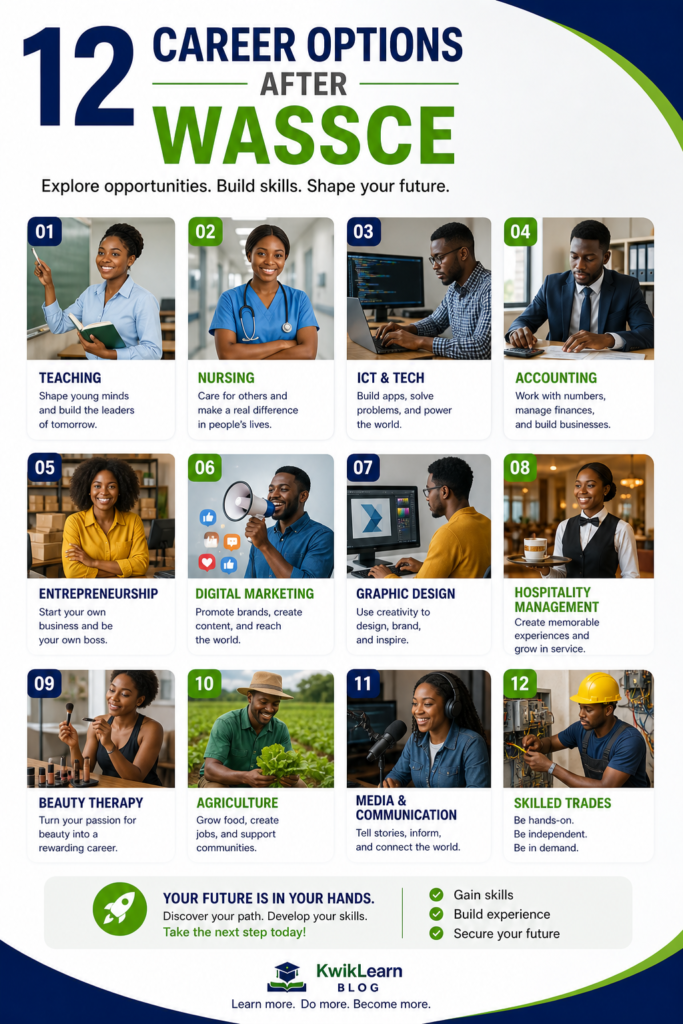
How to think about career options after WASSCE
Before you rush into any application, pause and ask a few honest questions. What subjects do you enjoy most? What kind of work do you imagine yourself doing? Can your family support full-time schooling right now, or do you need a path that allows you to earn while learning?
This matters because many students choose based on pressure rather than fit. A student with strong science grades may still prefer media, design, or business. Another student may want university but need to start with a diploma or a job because of money. That does not mean the dream is over. It just means the route may be different.
It also helps to think in stages. Your next step after WASSCE does not have to decide your whole life. It only needs to move you forward.
1. University education
For many students, university is the first option that comes to mind. If your grades meet the requirements, this can be a strong path into fields such as medicine, nursing, law, engineering, education, business, agriculture, communication, and social sciences.
University can open doors, but it also comes with trade-offs. It usually takes several years, and the cost can be high when you add tuition, accommodation, transport, and learning materials. It is best for students who are ready for academic work and have a clear reason for going, not just because everyone expects it.
If you choose this route, take time to compare programs carefully. The course name matters, but so do job prospects, practical training, and whether you can truly cope with the demands.
2. Technical and vocational education
Technical and vocational education is one of the smartest career options after WASSCE, especially for students who want practical skills and faster entry into work. Areas such as electrical installation, welding, automotive work, fashion design, catering, plumbing, construction, and electronics can lead to steady income and self-employment.
This path is often misunderstood. Some people still act as if TVET is only for students who could not make it elsewhere. That idea is outdated. Skilled technicians and artisans are needed everywhere, and many earn well because their skills solve real problems.
If you enjoy hands-on work, this route may suit you better than a purely academic program. The key is to train at a credible institution and take the learning seriously.
3. Nursing and health training programs
Health-related programs remain popular for good reason. Careers in nursing, community health, medical laboratory work, pharmacy support, and allied health can offer purpose, structure, and decent long-term opportunities.
That said, these programs are competitive and demanding. You need the right subject background, especially in science-based areas, and you must be prepared for disciplined study. If you are choosing this path only because it sounds secure, make sure you also have the interest and patience needed for healthcare work.
For students who like helping people and can work carefully under pressure, it can be a good fit.
4. Teacher training
If you enjoy explaining ideas, supporting younger learners, or making a difference in your community, teaching is worth considering. Colleges of education can prepare students for careers in basic education, and later you may still continue to earn higher qualifications.
Teaching is not always easy, and it should not be treated as a backup option for someone who has no interest in children or learning. But for the right person, it offers stability, service, and room to grow into leadership, school administration, curriculum work, or education technology.
In many communities, good teachers are still deeply needed. That makes this path both practical and meaningful.
5. Polytechnic, diploma, and HND programs
Not every student has to begin with a four-year degree. Diploma and HND programs can be an excellent bridge, especially for students who want more practical training in fields such as accounting, marketing, hospitality, IT, procurement, or engineering-related subjects.
This option works well for students who want a recognized qualification, a shorter route into work, or a stepping stone toward further study later. In some cases, it can be more affordable than starting at a university right away.
If your WASSCE results are mixed, this may be a smart way to keep progressing instead of feeling stuck.
6. Apprenticeship
Apprenticeship is a very real career path, not a last resort. Under a skilled craftsperson or business owner, you can learn hairdressing, tailoring, carpentry, welding, auto mechanics, beauty services, shoe making, and many other trades.
The biggest advantage is direct experience. You learn how work is actually done, how customers are handled, and how income is earned. The challenge is that the quality of training can vary. Some apprenticeships are excellent. Others leave learners doing errands without learning enough.
That is why it is important to choose carefully. A serious master or madam who teaches both skill and discipline can shape your future in a powerful way.
7. Learning digital skills
Digital skills have changed what is possible for young people. Even if you plan to go to school, learning a digital skill can give you an extra advantage. You might study graphic design, video editing, coding, data entry, digital marketing, UI design, content creation, or basic IT support.
This path is especially useful because it can work alongside other plans. A student in college can still earn from design. An apprentice can promote a business online. A job seeker with computer skills often stands out more than one without them.
Still, not every digital course is worth your money. Some training promises too much and teaches too little. Focus on skills that solve real problems and can be practiced with actual projects. Platforms like KwikLearn are part of why more students are discovering that useful skills can start small and grow over time.
8. Entrepreneurship and small business
Some students know early that they want to build something of their own. After WASSCE, that may mean starting a small business in fashion, food, printing, beauty, phone accessories, farm produce, online services, or tutoring.
Entrepreneurship sounds exciting, but it is not quick money. It takes planning, patience, and the ability to manage risk. Many small businesses fail because people start with energy but no basic record keeping, customer strategy, or cost control.
If this path interests you, start small and learn fast. Business works better when it is built on a real skill or clear demand.
9. Entry-level work while planning the next move
Sometimes the most realistic step is to work for a while. You may need to support yourself, save for school, help family, or gain exposure before deciding what comes next. Jobs in retail, customer service, office support, sales, hospitality, and basic administration can teach useful habits.
This path can be helpful, but it works best when it has a plan behind it. If you start working, decide what the job is helping you achieve. Are you saving for training? Building experience? Exploring an industry? Without a plan, one year can quietly become three.
Work can teach maturity, confidence, and responsibility. Just do not stop learning while you earn.
10. Rewriting papers or improving results
For some students, the best next move is to improve their WASSCE grades. That can be disappointing at first, but it is not failure. It is a strategy. If your results do not qualify you for the course or institution you want, rewriting one or more subjects may create better options.
This route requires honesty and discipline. You need to understand what went wrong the first time and prepare differently. Better revision habits, past questions, extra support, and stronger time management can make a real difference.
There is no shame in taking another shot at your goals.
How parents and students can choose wisely
The best decisions usually come from calm conversations, not pressure. Parents want security for their children, and students want a future they can believe in. Both matter. The goal is to balance ambition with reality.
Start with what is possible now, then build from there. Check entry requirements. Compare costs. Think about transport and accommodation. Ask whether the path leads to real skills, real work opportunities, or further study. A path that looks smaller today may still lead to a bigger future tomorrow.

A good future can start in different ways
When people talk about success after WASSCE, they often make it sound as if only one route counts. That is not true. A university student, a trained electrician, a nurse in training, a digital freelancer, and a small business owner can all be building strong futures.
The smartest move is not copying somebody else. It is choosing your next step with clear eyes, good information, and the courage to keep going. Your results matter, but they are not the whole story. What you do next matters too.
Students can also check official WASSCE information from the WAEC Ghana website and explore technical and vocational training opportunities through CTVET Ghana